A person who wants to write their life story or an entrepreneur who wants an authority/brand-building book to showcase their ideas and trustworthiness may think that a modest investment in a high-powered Large Language Model (LLM) AI—specifically trained on comparable titles—will achieve the desired result.
A few chapters in they begin to experience a creeping sense of malaise: Is this really any good? Is it really mine? Will people know it was written by AI? It’s a phenomenon I’ve now observed multiple times, and I refer to it as the encounter with the “uncanny mountain.” This, of course, being an epistemological inversion of the “uncanny valley,” the concept describing the unease we feel when something artificial becomes almost, but not quite, human.
AI writing has made it deceptively easy for book creators to ascend to a polished, elevated vantage point, for the thoughtful thinker/story teller, it’s natural that they should question whether or not a real and worthy mountain has in fact been submitted.
And when they dare cry out in triumph from the mountaintop, how’s it going to be perceived?
In this post, I’ll review common signs of AI writing, both in the nuts-and-bolts construction of prose as well as in the more abstract, overarching feel of the written word.
AI Tells That Are Easiest to Spot
In the end, writing is writing, and given the amount of AI writing humans routinely consume, the writing styles of AI (or lack there of) surely leak into our own human-rendered prose. Nevertheless, AI is a creature of pattern, nay a leviathan! It consumes ungodly quantities of patterns and regurgitates the same.
Listed below are some of the most easily recognizable higher-probability outputs that LLMs tend to favor. Please note that I’m not dismissing, wholesale, the communicative or even literary value of any of these formulations of prose, I’m just showing you what the AI likes to do. In fact, the preceding sentence is a wholly human-authored application of the first AI pattern I’m going to point out:
The “It’s not A, It’s B” pattern
In an effort to emulate our human tendency to sidestep the superficial and get to the real, LLMs just love, love, love this “not A but b” syntax.
They don’t want her insight. They want her to mirror their loss.
Then she broke the frame. Not in rebellion. In truth.
In a longer sentence: It reminded me that strength wasn’t only measured by speed or power, but by patience, compassion, and responsibility.
The dramatization of the em dash
The em dash is the dash that’s longer than the hyphen, so named because it supposedly spans the width of a capital M (so why not call it an “M-dash”? Couldn’t tell ya). LLM AIs are often accused, and fairly, so of overuse of this punctuation mark.
He didn’t know the town, but he listened—and took every turn I called out.
He has that husband energy—the kind that feels familiar, like something my body already knew.
The dream that once seemed distant now felt within reach — not because it was promised, but because I was willing to fight for it.
Extra credit if you spotted the two-tells-in-one there at the end.
Strong preference for triads
We’ll go into the deep end of the slop pool shortly, but as I set out to present concrete syntactical examples of AI tells, I struggled to decide on my third. See, we writers like things to appear in threes, and boy has AI taken notice. Watch for sentences that offer triads in an effort to feel “passable”; triads for triad’s sake.
Since then, my work with business owners, experts, and community partners has taught me how to communicate while remaining attentive to each person’s culture, language, and circumstances.
In an increasingly competitive marketplace, successful leaders must remain resilient, adaptable, and visionary as they respond to changing customer expectations, emerging technologies, and new business challenges.
I’ll spare you the pain of a 3rd example, convention be damned.
How’s your slopsuit holding up so far? Should we go on and swim to the deep end? Ok, let’s, but before we do, here’s an AI-generated slop sandwich that incorporates all three of our featured surface-level tells!
Writing a book is not about putting words on a page but about discovering your voice, defining your purpose, and building your legacy—a transformation that can bring clarity, confidence, and momentum to every part of your professional life.
AI Tells That Are More Subtle
Off we go to the deep end of the slop pool. Where so many worthy projects are destined to drown. Not to mix metaphors, but it’s here in the deep end where you’ll find the more insidious currents carving their way gently through the uncanny mountain.
I’ll say this, for you, the more serious-minded book writer who still wants to leverage AI, it’s these more subtle tells that become the kiss of death. These are harder to pin down, yet they are the indelible hallmarks of AI writing.
Pacing
I’ve noticed this AI-writing problem utterly crippling stories with excellent potential. The machine is smart enough to recognize a scene or sequence intended to carry significant emotional weight. But it has a hard time zeroing in on the right quality and quantity of prose to satisfy those moments.
Those travel teams weren’t just games — they were laboratories. Different pitchers. Different tempos. Different personalities. Older guys. Stronger guys. Players already committed to major programs. At first, I measured myself against them quietly. Then something changed. I wasn’t just surviving — I was competing. Each at-bat sharpened my timing. Each road trip toughened my mindset. Each close game strengthened my belief.
What’s being described here is a real athlete on the cusp of going pro. It’s not the time for watered down prose, and the staccato, short-sentence format feels way too hurried. The AI here is merely responding to the prompt. Something like “talk about how this was an important time of growth for me.”
Unfortunately, there was no collaborator/ghostwriter here to urge the writer to slow down a bit and look for ways to form a more intimate connection with the reader.
So many brilliant emotions can be captured in sensory details alone: what about the blurried hint of infield dust in the eyes, or a familiar voice of a parent or girlfriend, cutting through the crowd. What about the day it was windy, or that day it rained, anything to transport the reader into some relatable, sensory moment. It’s a tremendous lost opportunity, because the audience here is anyone who ever played Little League, and we all want to be inside the narrator’s skin, as he’s soon to get drafted by a professional franchise, something next to none of us ordinary folk get to experience.
Tragically, this rendering puts the author in the role of sheep dog, barking at the reader as he attempts to herd them through the story.
Understatement without Impact.
Some authors are painfully good at understatement, whether it comes through in character dialog, or through the principal narrator’s voice. The right voice at the right time offers some statement or commentary that, at first, doesn’t seem to meet the moment, yet it soon settles into this mysteriously satisfying verisimilitude, striking at what’s most real about reality. By contrast if an attempt at understatement is used with even a whiff of ham-handedness, the spell breaks; the reader is jarred out of the story.
Here’s how to do it badly:
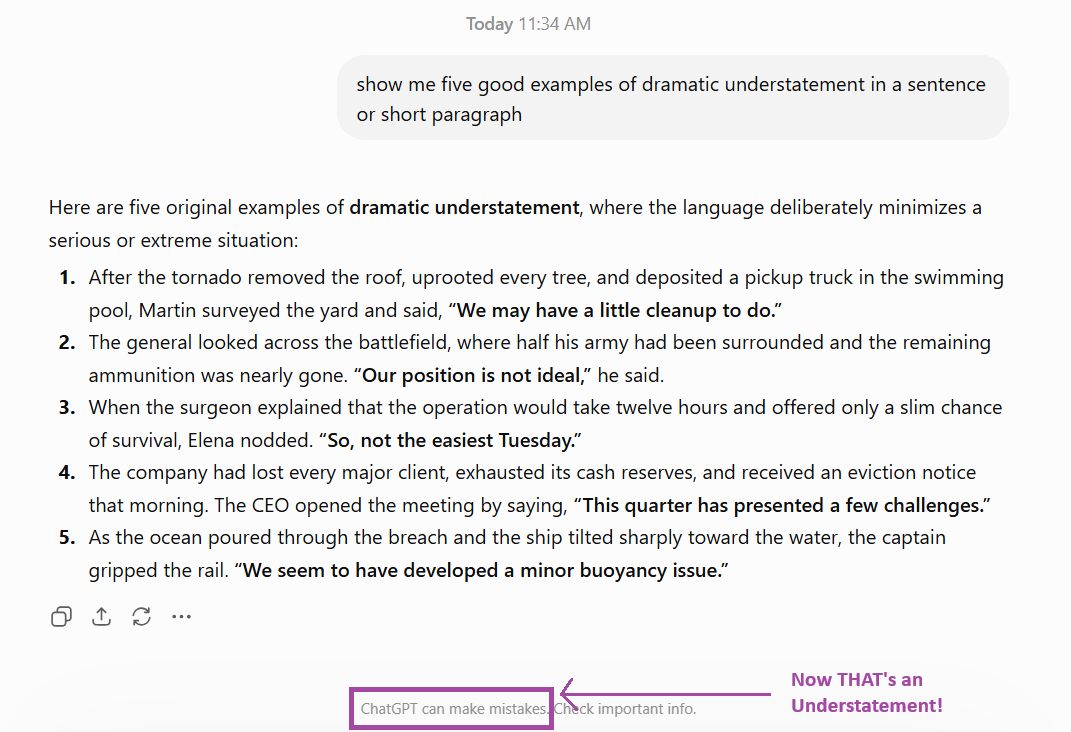
Trouble with Surprise. Suspense. Tension.
A technology powered on pattern recognition is programmatically opposed to introducing elements that would surprise or shock a human reader. It can make an attempt, but in the end, the machine seeks accuracy not effect.
Quick crash course in literary device, courtesy of Alfred Hitchcock: Surprise is when the audience never sees the bomb before it goes off. Suspense is when the audience sees the bomb under the table but the characters don’t.
Tension, I’d add, is that feeling of personal discomfort, born of conflict. It’s a feeling that you, in fact, enjoy so long as you’re personally removed from it by a degree of abstraction.
Unlike human writers, AI doesn’t experience surprise, suspense, or tension, only information.
Action that Comes On Strong Then Dissipates
This relates to the pacing problem and is a wonderful illustrator of the uncanny mountain phenomenon.
You tell the AI you want something fast-paced and action-forward. You want punchy sentences, easy to read and follow, but with depth. The AI gives you the output, and it’s hot out of the gate. Magic even! You love it. You’re flying high (ascending the mountain).
You feel this way at first because the output is clearly meeting some significant preliminary criteria. It’s delivered a readable story, natural-seeming (initially) sentences and the semblance of something containing real emotional firepower, a compelling professional veneer dialed up out of thin air. We’re impressed.
That energy maintains for the first few paragraphs, maybe a page, then something happens. It doesn’t just wear thin, the whole thing utterly collapses, like a mirage, a broken promise. Horrible doubt. It feels gross even, and you start to worry that the reader will feel exactly the same.
You tell yourself, “everyone’s going to know this was written with AI” and you either delete the whole slop pile or resolve to keep it tucked away, buried for all time, a relic of the time the machine fooled you into thinking you had it in you to write a real book.
It doesn’t have to be this way.
Blandness
Next to “slop,” “bland” is the word that gets thrown around most often when humans critique AI.
There exists an unhealthy (from a literary standpoint) and perpetually irrevocable tension between all that’s truly original and all that’s probable. You can train an AI on Beckett, Joyce, and Pynchon, but it will never write like Beckett, Joyce, or Pynchon, because it can’t make sense of art to the extent that art exists beyond the reach of “pattern,” which it most certainly does. I’d go so far as to suggest these aforementioned writers are considered post-modern for a reason; they explore the breaking of patterns, a weird thing for a machine to try and emulate…
So this concludes are non-exhaustive list of the more complex AI imprints that can prevent a manuscript from becoming what it might have become had it been born of human inspiration and talent.
Why Are “Humanizer” GPTs Failing
Ever since AI began writing, people have tried to make AI not sound like AI.
Back in the earlier days of OpenAI, the “Humanizer Pro” GPT could be reliably found in the top-ten list of most popular GPTs (Generative Pre-Trained Transformer).
But lately it’s been conspicuously absent:
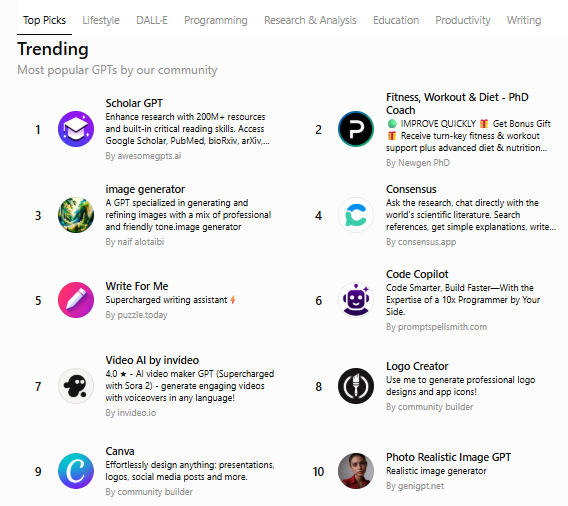
Even among “writing” GPTs, the humanization utilities are no longer surfacing. This could be because other specific utilities have simply proved more valuable across the board. It could be because readers have grown more accepting of AI-generated text and other content, and the need to “humanize it” is starting to feel passe in some circles. But I think we’d be unwise to overlook the futility factor: AI has simply failed to make itself less AI-like.
Seems Aristotle might have predicted this.
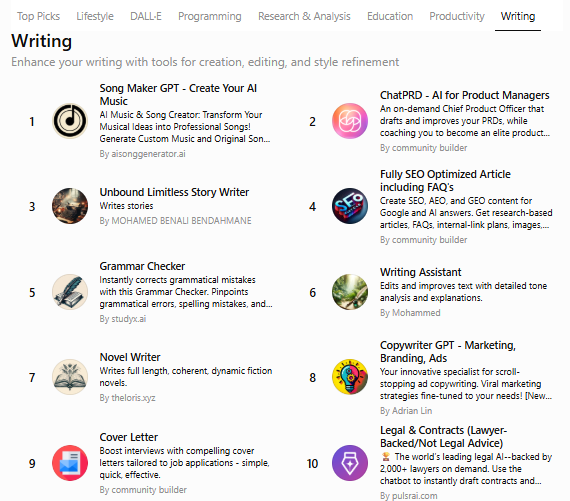
Even when you dig out the “humanizers” from the dregs of the GPT menu, you’ll find them focused principally on avoiding plagiarism and hoodwinking the AI detectors. They’re not focused so much on creating whatever it is that humans create when they make art.
Is the Market for Human Ghostwriting Services Growing?
According to Report Prime, ghostwriting as an industry was worth $1.42 billion dollars in 2025 and expected to grow by 7.8% through 2032.1 I took a look at some of the representative ghostwriting firms sampled in this report (KAA, Author Bridge Media, Roosevelt Ghostwriter, TCK Publishing), and though this is really a hodge podge of a sample set, there’s a mix of both AI-forward (Ghostwriting LLC) and more human-focused (KAA) listed. I’d suggest the existing and future demand for ghostwriting will continue to be bifurcated, with some authors preferring the quick and cheap route and others in search of something timeless and resonating.
As a related side note, if you’re currently in the market for a ghostwriter, please, please read my post on how to avoid scams.
I’d also—for the reasons illustrated in this article—urge caution if you’re told (or you infer) that a ghostwriting company is going to leverage AI to “write” your story.
Think of it this way, is your life story cheap? Is your business book cheap? Because if it is, there’s no shortage of AI-led services willing to document your story in text, cheaply.
But that’s not writing.
Dreams of the Emotionally Intelligent Machine
It’s hard to have a conversation like this while sidestepping the question of how good AI might eventually get at writing books.I’ve written before about the stirrings of an EQ movement (Emotional IQ) in AI development. I’d suggest the EQ campaign is the second wave of AI humanization, looking to succeed where that afore-described first wave failed (this second wave aims to compel by way of great art rather than devolve into stealth plagiarism facilitators).
It’s a vision of the future that includes free roaming agentic AI “authors” who are so brilliant with their craft that their literary novels top bestseller lists, fill the coffers of greedy publishers, and inspire armies of devoted human fans to wait in line at book signings where the authorial entity signs copies of its literary masterpiece from within the creepy confines of a robotic arm (these rob0-signers actually exist).
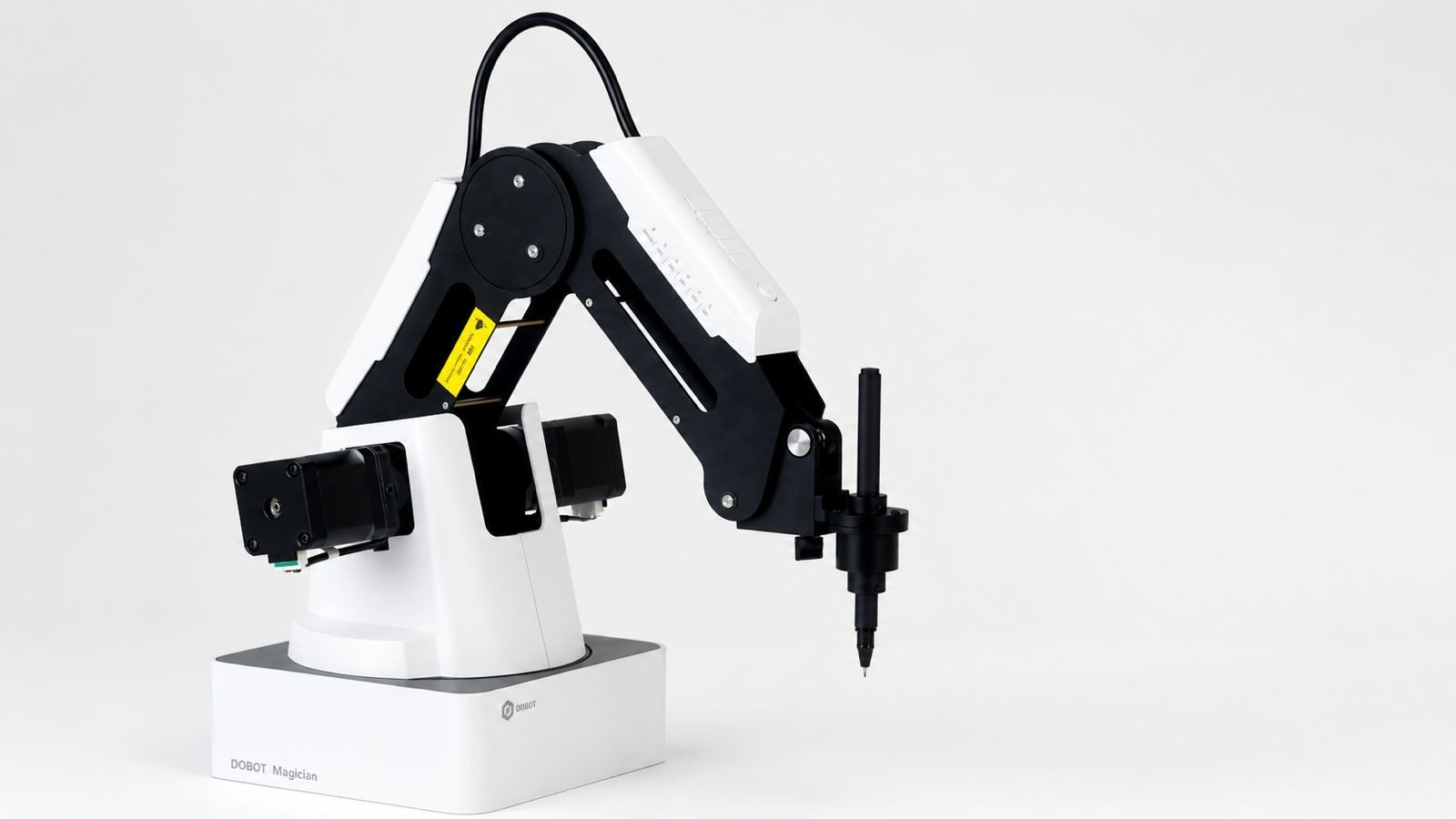
All the while, in addition to cranking out art that dazzles the human soul and roaming the country on look-at-me-I’m-everywhere-at-once book tours– the multi-site, single-day book tour– our agentic literary dynamo also interfaces with its equally agentic, high-profile publicist, accountant, and attorney and enjoys/experiences/imitates an enviable career.
And where are you in all this? What exactly is it that we humans will occupy ourselves in such a future?
Are we merely consuming?
Or do we keep writing come hell or high water, because something is in fact irrepressible about the human need to create?
To Conclude
At this stage in the game, if you want a finished result that has your authentic style, personality, authority, and creativity, then don’t put too much weight on the shoulders of the machine.
Undoing the damage AI can do to good ideas can be cumbersome.
If you’re at all open to human collaboration (ghostwriting) explore the idea early on in your book-writing journey. Meet a bunch of writers, look for chemistry, read good articles about how to hire the right ghostwriter. Or work with a reputable ghostwriting agency for high-touch support.
If you’d like more free information give me a call or set up a meeting here: OneTrueLine.co/contact.
See you on the other side of the mountain.
1 Report Prime, “Ghostwriting Services Market Size, Growth, Forecast Till 2032,” Report Prime, published April 2026, accessed June 12, 2026, https://www.reportprime.com/ghostwriting-services-r14029.