“To me, the difference was so obvious immediately. Just down to the details that you used, like making eye contact with a woodpecker.”
-New York Times Opinions Editor, Susannah Meadows, commenting on the obvious difference between an AI-written short story and one written by author, Curtis Sittenfeld, after a blind reading in 2024.
“A man can be destroyed but never defeated.”
- Ernest Hemingway
We writers love to critique AI slop but we’re afraid to ask one simple question: how much longer can we expect to hold our edge?
Might the machines soon satisfy even the most discerning of literary appetites? And what does it mean if they do?
All I’m certain of is that they will try.
A slew of super smart entrepreneurs and billionaire funders are placing big bets on AI’s ability to eventually “get it right.” They lament that existing LLM writers are a far cry from Shakespeare, Dostoevsky, Wallace, or Pynchon, and they’d like to have a go at changing that.
I met one such entrepreneur recently. The intro was made by a very lifelike AI agent called Boardy. AI who connected me with a human whom I’ll refer to from here on out as “the pilot fish.”
The pilot fish told me that the human being’s capacity for setting taste in art is set to expire. Soon, no one is going to know what’s good anymore. All we’ll know is whether we’re being entertained. The next gen of slop will be delivered by the next gen of hyper-targeted algorithms and they shall make happy swine of us all.
The solution, according to this human, is to collect massive amounts of data, right now, from the vanishing sliver of the living that still knows how to recognize what’s good. Preserve the living artists’ sense of taste. Preserve it in the cloud. Preserve, he kept saying, because it’s all destined to be swept away by the art to come. The future of art belongs to AI, and the AI-generated writing, movies, games, and all the rest will so dazzle the senses that human-created art will cease to be a thing. No one will want it, and because of that, no one will want to make it.
I of course, begged to differ, and expressed my opinions. And he conceded only that a cottage industry of high-priced human-rendered relics might still percolate among the wealthy, purely as a function of their rarity.
The pilot fish works in concert with a prestigious computer science lab at a major Southern California university, and he’d like for literary nerds like me to help bestow AI with greater emotional intelligence. Per his manifesto: “The labs themselves now name it [emotional intelligence; EQ] as the central unsolved problem” among AI developers.
A relatable way to understand the EQ problem is through the contemporary phenomenon of AI sycophancy; ChatGPT in particular is known for kissing up to the user to the point of blegh. And we like being kissed up to, don’t we? Admit it. We do, a little. Just not to the point of blegh. Well, apparently that special space between thanks for the compliment and blegh is really tough for the machines to navigate right now. Your standard, everyman LLM doesn’t analyze voice tone or facial features. It doesn’t know whether you’re presently in need of a pick-me-up or whether you’d instead be annoyed by one.
But they’re working on it.
So, apparently all this “EQ” data is going to pour into AI-generated art as well, and—um, I dunno—take awe and poignancy to new heights!? My correspondent spoke not only of fine literary writings, but of weird near-future fables, like emotionally resonant AI screen actors, agentic teen heartthrobs and such, that will forge powerful bonds with human audiences and more or less go Beatlemania all over future generations. More than that, these public personalities will manage their own careers via agentic deployment of their managerial budgets to pay equally agentic, equally artificial publicists, talent agents, lawyers, and then some.
His thesis: once these things run on as much EQ as they do IQ, then they can pretty much do anything.
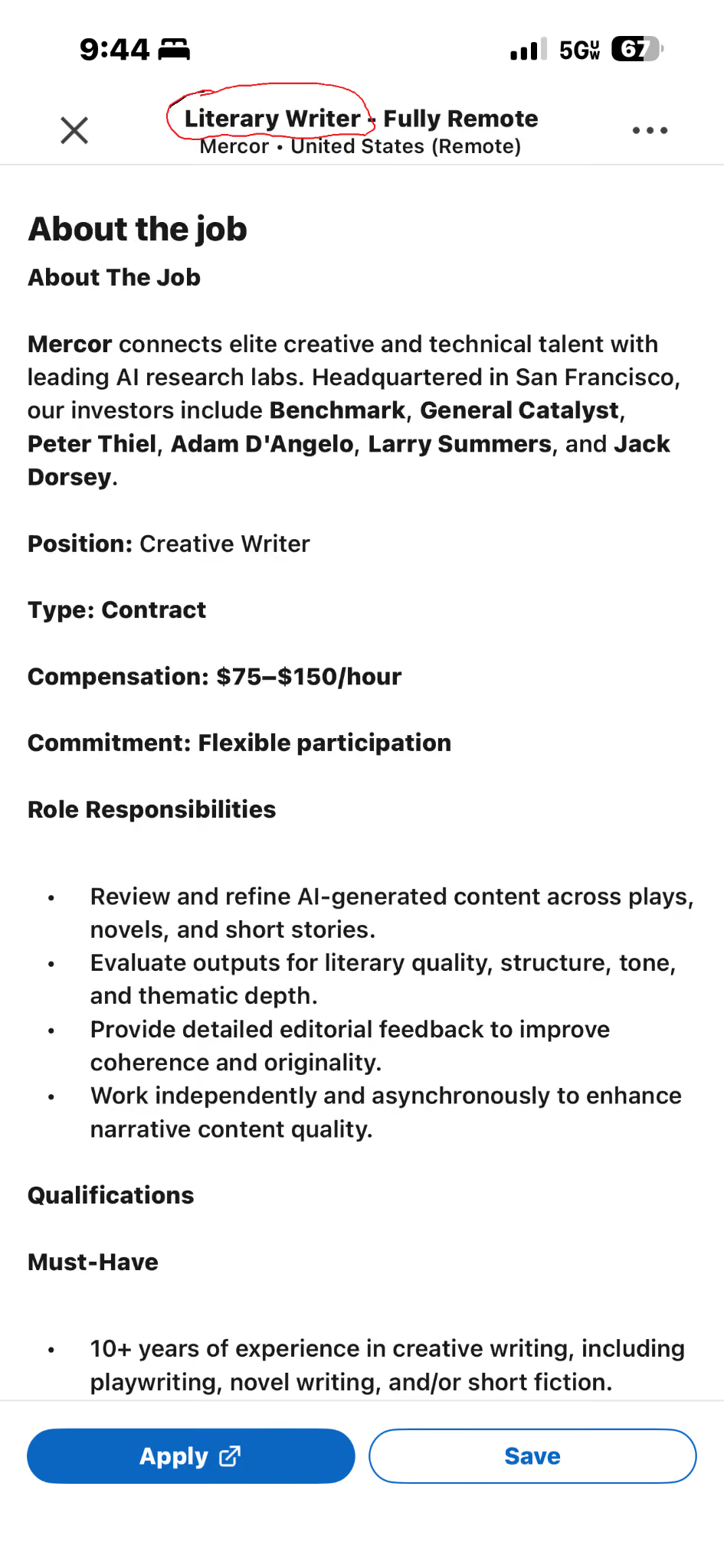
And this guy I talked to is far from the only developer engaged in the quest to seek superior machine emotions. Peter Thiel-funded AI development company, Mercor, is busy, as we speak, throwing money at artists willing to help Mercor make AI literary outputs suck less. The firm seeks award-winning playwrights and novelists with “10+ years of experience,” and a “substantial body of published work” to assess the “structure and tone” of AI-generated plays, and to size up the “thematic depth” of AI-generated novels.
Again, Hemingway is instructive. In his memoir, A Movable Feast, he talked about the “pilot fish” approaching him. And before long he ended up in rooms crowded with elites whom he said, in retrospect, were unworthy of hearing his work read aloud. None of it ended well.
If the rampant commercialization of one’s art is enough to bring on disgust and dread, then how much more disgusting would it be for an artist to sing for the health and pleasure of a billionaire’s pet robot?
Credit to the many qualified writers who passed on the Mercor listing. I noticed that between April and May, Mercor adjusted the job listing from “Literary Writer” to “Literary Specialist” and from “Playwright” to “Creative Writer.” Perhaps they’re having trouble getting real artists to play ball. They may have to settle for critics.

If you want good news, I have it.
The will to consume is strong, but it won’t destroy the will to create. Ask my seven-year-old who routinely brings home stacks of his own commercially unviable artwork. Or ask the struggling novelists and playwrights who continue to ply their trade in a field where even immense talent is regularly confined to obscurity and poverty. Ask business writers who tell you that writing is thinking. And thinking is good.
“‘Doing it yourself’ is the whole point of writing, really, of every art,” says author John Lauricella.
In their own way the pilot fish might agree with Lauricella. Peter Thiel might agree with Lauricella. Their quest too, like art, is about doing, a journey, a destination. No sanctimonious rage or accusations of hubris will deter them from building as close as they can to sentient, nor stop them from dreaming of what lay beyond.
Yet, taste, I’m certain, is made of such ever-slippery, always-evolving phenomena. To even make an attempt at bottling it inside an algorithm would require more than your run-of-the-mill pattern recognition. The “patterns” sought would be ephemeral and subjective. They’d transcend time, space, culture, and more. Such work would require the deft mechanical handling and resolving of many contradictions.
It will likely be tried and will likely fail, and at an obscene cost to our planet, and, as the pilot fish warned, might still find a way to assail our very will to create.
Even if Peter Thiel were to succeed in recruiting to Mercor every Pulitzer-winning writer still living, they’ll still only capture a glimpse of what it is to truly feel, an ultimately insignificant, finite partition of infinite human creative processing power, some brilliant signal with diminishing returns.
Don’t believe their threats.
When the advent of modern photography required painters to answer for their craft, we didn’t get more picture consumption, we got Jackson Pollock.
Creativity beats consumption. Because no computer, no matter how powerful, will ever entertain away the urge we humans have to dream on our own.