Why Serious Authors Still Choose Human Collaboration Over AI
“Doing it yourself is the whole point of writing, really, of every art.”
-John Lauricella, author of The China Plot, Unforgettable, and 2094.
On the topic of AI replacing humans in the world of writing and publishing, my opinion has evolved from hopeful, to cautiously optimistic, to bullish.
The human ghostwriters I know are all busier than ever. According to one NYT best-selling writer in my network, AI isn’t causing him to be passed over for jobs. "But it’s leading to other annoyances. Clients send me reams of AI-generated slop… and tell me all I have to do is fill in the blanks.”
I’ve seen this pattern play out a few times. Someone wants to write a book, and they think it'll be rather easy with AI. They dig into the project, but find the output is a mess—unconstrained, doesn’t feel true, doesn’t fit their vision—and they call in a ghostwriter.
There’s a link between bookmaking craft and the impulse to seek out the human. Readers, for example, when polled at large, say they don’t want to pay for AI-generated books,1 a reasonable position, especially when you consider the fact that the “creators” of the AI-generated books hold no legitimate copyright over the material produced.2
Should the preference for human-authored books prevail, and I think it will, then we’re left to contemplate the following: what, pray tell, is the essence of the human fingerprint on a creative work?
I picked this Greek word/concept out of a book recently: egregore. It’s this thing in esoteric traditions where the combined, focused energies of living beings creates, in theory a new and separate living entity: a spirit, the egregore. If you’ve ever been emotionally, spiritually, and vocally invested in a sports event—on your feet in front of the TV or at an arena alongside strangers in similar colors—then you’re contributing to the egregore for that particular collective. But what about the spirits moved to life through a jam session with your band, or through a dynamic ghostwriting collaboration with a creative partner? The egregores born there can ripple through communities and cultures, bringing news of beauty and inspiration. I’d argue that human works inspire, because they are the product of inspiration.
Might Plato himself posit that it’s this lack of sufficient egregore that gives the AI-generated book product its processed-cheese-food-feel? Why is it that would-be authors get stumped by the limitations of AI, when attempting a work of even modest creative substance?
The intractable problem of AI-human creative writing collaboration is that it’s not really a collaboration. The AI systems amass and organize troves of data, including highly probabilistic formulations of prose. Rather than contribute from a place of inspiration, they contribute by way of prompts and training. In my attempt to explain the persistent undercurrent of blandness in AI-generated texts, I’ve suggested that it suffers from a kind of perpetual writer’s block; whereas a writer finds purpose and pleasure in truth, the AI’s highest purpose can only be accuracy. Accuracy vs. Truth: If the soul exists, then there’s a difference.
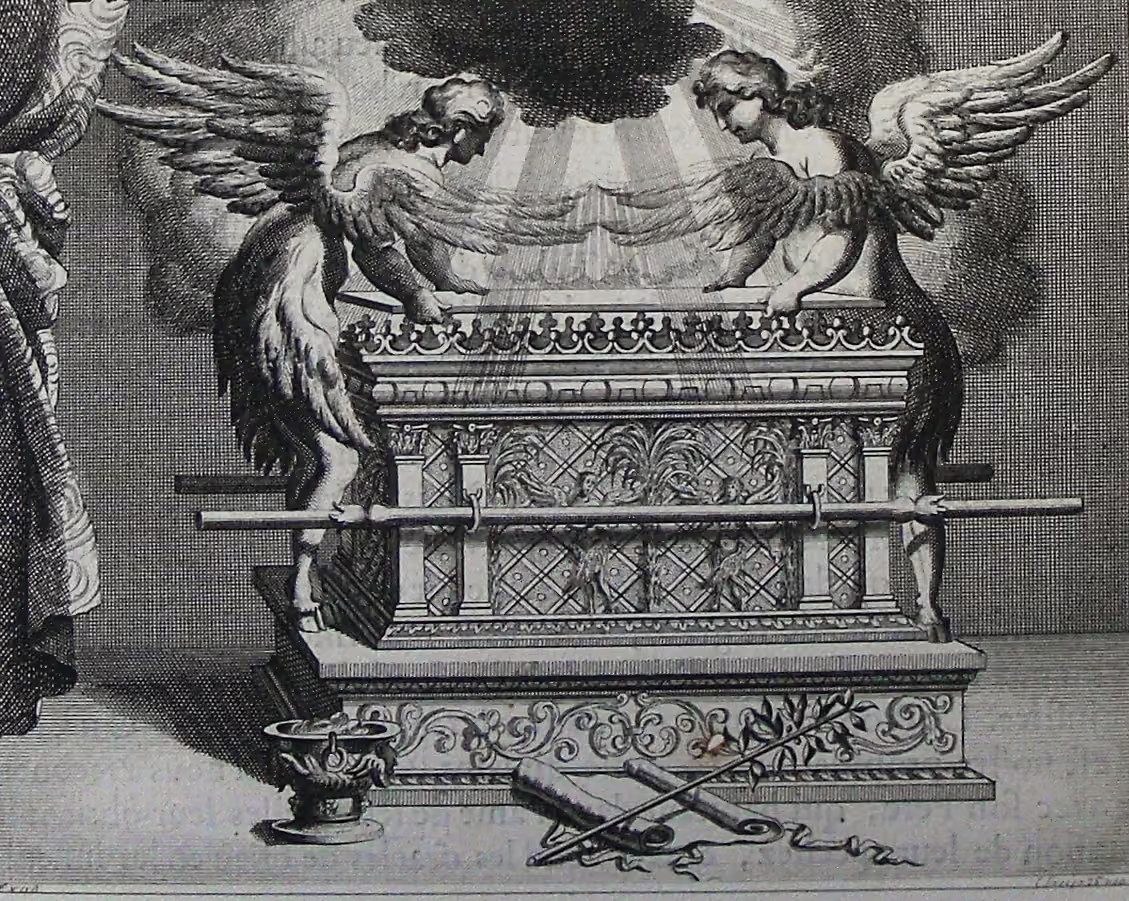
All this to say that the tightly aligned, dynamic, human collaboration between author and ghost is capable, and uniquely so, of producing a formidable egregore, one worthy of being enshrined and proliferated (sometimes wildly so) in the form of a powerful artifact, the book. To print and bind hundreds of pages of AI-generated text is to present a false ark of the covenant. Caveat Emptor. No God inside. I may have my Indiana Jones movies mixed up, but I seem to recall false arks as being a generally ugly and precarious business.
According to a whitepaper released by Gotham Ghostwriters late last year, there’s a sizable segment of writing professionals, largely content marketing writers, who’ve made the choice to go all out on AI tools for writing and everything else. They maintain that AI helps them be more productive and the data show that their pro-tech posture has come with financial rewards. According to one measurement, the writing pros who identified as AI power users had a median income of $120,100, 64% higher than the 39% of writing pros who said they rarely or never used AI for any purpose.
What’s funny though is that even among this power-user segment, 63% believe that “AI is contributing to the trend of text that is more bland and boring” a conviction held by 78% of writing professionals at large. Furthermore, 53% of AI power-users joined 79% of all writing pros in confessing that “AI-generated text is eroding the perception of value and expertise that experienced writers bring to a project.”3
It’s not hard to see what’s happening. The craft of authentic creative writing is being sacrificed for expediency, with mediocrity as its byproduct (slop, waste, pollutant). It’s been said among writers that AI makes everyone adequate but cannot make anyone excellent. I’m bullish on the future of my craft, because I’m not convinced that AI can attain real excellence in writing, and I believe that excellence, true to its nature, will insist on being appreciated.
So how do we best serve the would-be author looking for ghostwriting support that will deliver not adequate but excellent work product? After all, you could hire the most expensive and well-vetted ghostwriter on the planet, but what if they’re having a hard day financially? How do you know they won’t give in to expedient mediocrity and grift, delivering an output that could have been had for a fraction of the price through some “human supervised AI-authored” alternative?
We could talk about artistic pride. We could talk about AI detectors. We could talk about the Author Guild’s Human Authored Certification. We could even talk about high-tech, proof-of-work style production monitoring systems and software that flags and ferret out LLM fingerprints in real time. Short of that, I’d say that the ghostwriting business will continue to thrive on trust, trust between writer and author, both believing in the value of dynamic human collaboration, both in search of something great, an artifact truly worthy of the spirit they’ve brought to life.
1) Institute for Market Decisions (NIM). “Consumer Response to AI‑Generated Books in a Pressured Market.” Nuremberg Institute for Market Decisions, February 6 2025.
2) Copyright Registration Guidance: Works Containing Material Generated by Artificial Intelligence. Washington, DC: U.S. Copyright Office, 2023.
3) Gotham Ghostwriters and Josh Bernoff, AI and the Writing Profession: A Comprehensive Survey & Analysis (New York: Gotham Ghostwriters and WOBS LLC, 2025).