Why You Should Pay a Ghostwriter at least $80,000 to Write Your Book
What is the market price of a feature-length manuscript written for hire? OneTrueLine agency founder, Bryan Basamanowicz, talks hard numbers and explains why trust is the ultimate currency.

“Any ghostwriting fee can look outrageous to one author, and perfectly reasonable to another, depending on what they believe the book can become.”
- ChatGPT
This post will be chock-full of hard numbers, but before digging into all that is fully quantifiable, I should acknowledge that which is abstract but of superior relevance.
It took me over a decade to fully understand what I’ll now try and relay to you in a single sentence: The price to hire a ghostwriter for your book, though extremely relevant, should be considered secondary, because what’s primary in a good ghostwriting relationship is trust.
If the ghostwriter, through vetting, interviews, portfolio samples, and good vibes, becomes trusted, then the pricing is more matter-of-fact. The price is a straightforward reflection of their professional capacity. There may be room for some negotiation, but not much. In fact, if the client believes in the ghostwriter’s talent and integrity, then they’re inclined to worry more about paying them too little as opposed to too much.
For me, as a ghostwriting agency head, my job is to facilitate collaborations that allow ghostwriters to become creatively invested in the work at hand. Writing a book is a big job and embedded in each project are thousands of small decision points. More than a few of these will require the writer to choose between expediency and quality, and I want to ensure that quality is chosen at every juncture.
I promised hard numbers, so here’s my take on the marketplace in 2026: pay a vetted, reputable writer that you trust $80,000 for a feature-length manuscript (nonfiction, memoir, novel) and odds are your final deliverable will be excellent.
$80,000, at this moment in time, represents my best effort to simplify a vast, multi-faceted, and highly subjective market. Nevertheless, ghostwriting deals close all the time well north of $150,000 or well under $50,000.
Let’s consider the factors in play.
Things to Consider Before Finalizing Your Deal with a Ghostwriter
“I have always found that plans are useless, but planning is indispensable”
-Dwight Eisenhower
The journey from idea to feature-length manuscript is difficult to chart with precision. You come in with an outline and a production plan, but once the drafting begins, new ideas and alternative directions present themselves. For this reason, it’s important to have a solid working cadence with your ghostwriter and be able to creatively adapt as needed. This is also why it’s crucial to measure out and plan for all reasonably foreseeable elements of your project. When it comes to pricing out a job, certain key factors represent foreseeable and significant investments of a ghostwriter’s time and energy. They should be spelled out in your contract.
Examples include:
A) Total word count target.
B) An estimated number of interviews required along with a listing of parties to be interviewed.
C) Research and background reading load. Will the writer need to spend a lot of time refining and deepening their knowledge on certain topics?
D) Sources of feedback. Will the writer take notes and direction only from the client/author or will other parties be involved, such as the client’s spouse or other family members or colleagues, editors, beta readers, lawyers, or compliance officers?
E) The total number of planned revisions to the manuscript and their nature. Some writers insist on one and only one round of revisions. Others offer two rounds but require that the second round be limited to corrections of factual error. Others offer endless revisions.
Assessing all that’s quantifiable in a ghostwriting engagement will provide a measure of predictability that will help to inform total cost.
But what about the slew of factors that don’t become apparent until long after the contract is signed and the work is well underway?
The Nature of the “Unknown Unknowns” in a Ghostwriting Agreement
My parish recently completed a modest construction project: a pavilion with a built-in donut counter, some nice new restrooms, and an assembly area, probably not much more than 1,200 square feet altogether. Yet, the final cost of the job was an astonishing $1.3M. We were told that issues began to surface once the digging started. Old pipes had to be cleared out, the new foundation had to be carefully molded. The original drainage design wouldn’t drain and had to be rethought.
You see where I’m going with this. Though it’s part of a ghostwriter’s job to guard against scope creep, things come up. In a recent nonfiction memoir project, my beta reader identified one specific chapter that required more authoritative, well-cited research. In that same project, our publisher flagged potentially libelous material and insisted on greater degrees of abstraction from real people, places, and events, beyond just aliases. In another project, a remarkable client-ghostwriter chemistry resulted in a much lengthier, more comprehensive text than what was originally envisioned (and contracted for). These and countless other unforeseen circumstances can arise in the dense and lengthy, messy creative process that is book writing.
Someone has to respond to the unplanned. Someone has to get in there, assess the new reality on the ground, and take care of business. The trusted ghostwriter and/or book production team that responds with speed, competency, and creative integrity is worth their weight in gold.
More Hard Numbers and Rationales for Deviation
I promised to be very direct on this topic. And, as I mentioned earlier, $80,000 is good. It may not be good for you, but that’s the price that’s good for me as a buyer, at least for most types of feature-length books: memoirs, self-help, novels, general nonfiction. It’s what I’d love to pay if the writer is trusted and well-vetted.
It’s worth noting that this figure, $80,000, for a 50-to-60K-word feature is also a modest step up from the famous $1-per-word benchmark rate for high-quality professional ghostwriting.1 So why am I willing to pay extra? The answer, in some cases, is rather simple; in other cases, extraordinarily complex.
Let’s begin with the simple predicament of the higher-end ghostwriter. Ghostwriting legend J.R. “doesn’t even need his own website” Moehringer. Moehringer broke into the ghostwriting business by penning the incomparable Open by Andre Agassi. And, as the name implies, Moehringer got the goods. To say he delivered would be an understatement. Open proved a commercial and critical success, and is considered one of the greatest sports memoirs ever written.2 A little over a decade later, in 2023, Moehringer came up with another ghostwriting Grand Slam title, Spare, the memoir of Prince Harry. Needless to say, these author-above-the-title-book projects were conceived within Big 5 houses, with sales forecasts, marketing, and publicity plans. Moehringer was already a Pulitzer Prize-winning journalist when he wrote Open, so yeah, for a variety of very good reasons, writers like Moehringer can land ghostwriting gigs that break well into the six-figure range.
In more general terms, you don’t have to be a Pulitzer Prize winner to get paid a lot. If a well-resourced publisher is driving the project with an expectation of commercial success, and the publisher knows and trusts the ghostwriter, then jobs can be had that certainly exceed the average payday.
In other scenarios, a professional publisher may not be involved at all, and a client will still spend well in excess of $80,000 for a ghostwriter. In most cases, the client is a high or ultra-high net worth individual, business, or family that just wants the job done well. They want low friction and a superior product. Again, trust is the driver. If this client trusts that you can meet their expectations, then such an assurance is simply worth more than the money being spent. A panelist at last year’s Gathering of the Ghosts conference said that her price was $110,000 for a book and no less. She didn’t have the resume of J.R. Moehringer. She just felt that $110,000 was what her work was worth. Her bids, she claims, are routinely rejected, sometimes 70 or more in a row before finally getting to a yes.
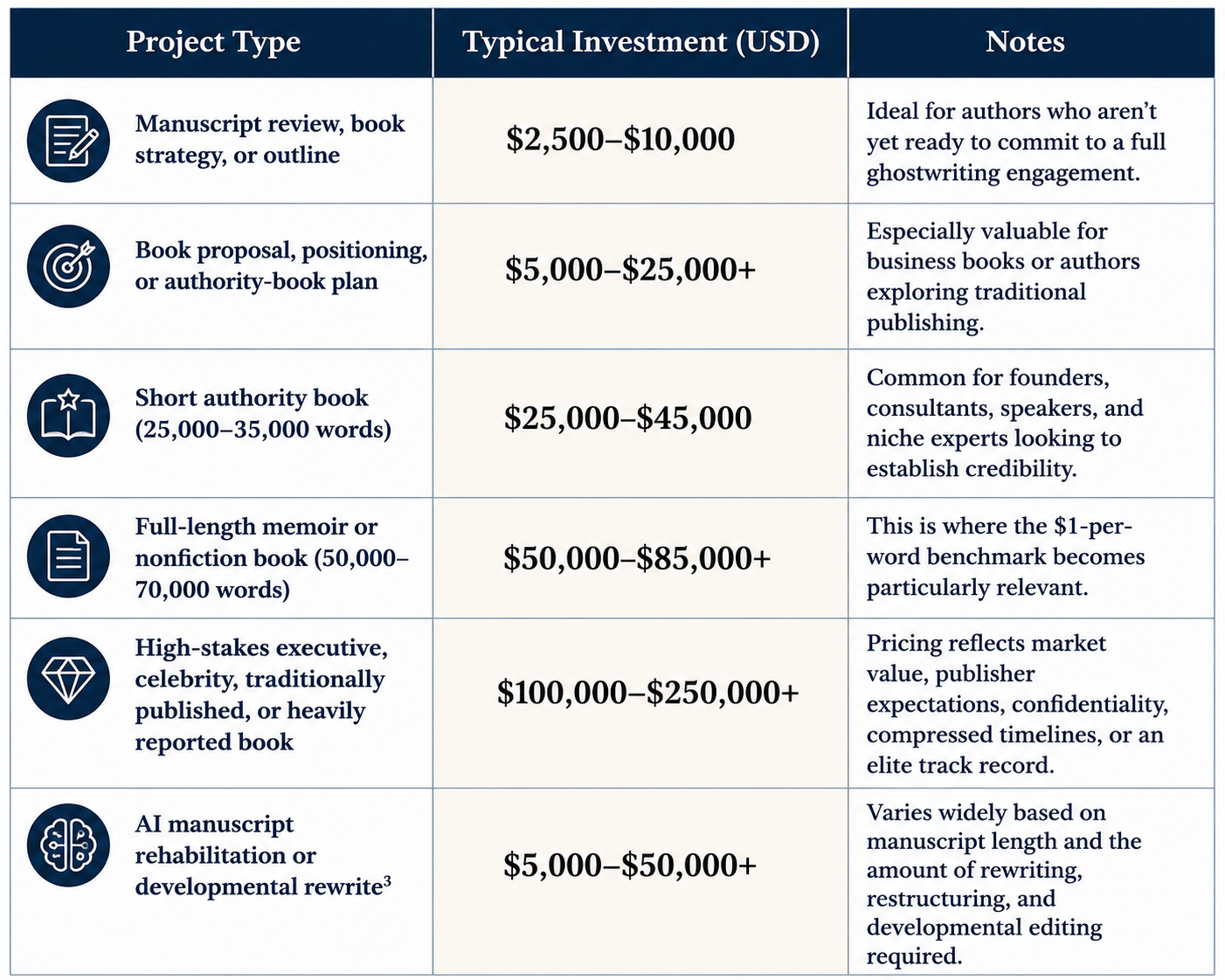
I’ll leave you with a chart depicting some more hard numbers reflecting what you might find in this marketplace:
If you’d like to get a customized assessment on pricing, process, or any other aspect of the ghostwriting craft, book a consultation with us here: onetrueline.co/contact.
1 For a deep understanding of how ghostwriters think about their pricing, allow me to acquaint you with a long-enduring frame of reference: “$1 per word.”
Back in my freelancing days, before founding the OneTrueLine ghostwriting agency, I was introduced to a book marketing consultant named Martin Leitner whose spouse, long-time memoir ghostwriter, Christina Schweighofer, was kind enough to provide me with a basic ghostwriting contract template (this was in early 2023, before such templates could be summoned via a simple prompt). Having many years of first-hand experience living with a serious ghostwriter, Martin told me in no uncertain terms that “no one should write a book for less than $50,000”. And this of course, was wisdom imparted a bit late, seeing as I was already in contract on my first gig, and it was a little more than 20% less than Martin’s benchmark. That same year I was introduced to a ghostwriter named Robert Woodcox who came bearing a long and admirable career and offered paid consulting to “up-and-comers.” Robert said, “What you’re trying to get to is a dollar a word.” Keep in mind, this is in 2023 and the notion of $1/word was generally copacetic with Martin’s “no less than $50,000,” seeing as 50,000 is a suitable minimum length for a feature-length manuscript (A bit long maybe for an authority-driven business book and a little short for a substantial work of nonfiction; see the pricing table below). While Martin framed $1/word as bare minimum—which is in keeping with Martin’s ongoing-to-this-day, famous advocacy for paying ghostwriters more—Robert's framing by contrast was aspirational, as in this is what you’re trying to obtain.
In any case, I got lost in my project, discovered that the workload was indeed more than I’d bargained for (damn those unknown unknowns *shakes fist*), and I resolved to raise my price prior to taking on my next feature-length project.
Fast-forward one year. 2024. The first-ever “Gathering of the Ghosts” conference in New York. Wall-to-wall ghostwriters. Perhaps the most resounding consensus to emerge at that inaugural was the idea that ghostwriters are too timid in the marketplace and need to start raising their ticket price.
Fast forward again, another year and change; it’s late 2025. The second-ever (now annual-ish) Gathering of the Ghosts is underway. I connect with a handful of ghostwriters who stand by the mantra, $1/word. It’s now got the feel of a labor union credo: This is our baseline demand! Not that it’s particularly uniform across the board; you can still find plenty of writers who will take less, but what I’ve noticed is that the $1/word paradigm/demand has become, in 2026, the mark of an emerging pro, keyword being emerging. The writers who quote this price are beginning to summon their inner swagger as creative professionals. They’re not scribes. They’ve already done their time kneeling at the footstools of their important, wealthy benefactors, dutifully transcribing into to the written word all the many pearls of wisdom that come pouring forth. No, these writers have realized that a big part of their job is to actually take care of their clients. To push back on bad ideas. To fight for their own good ones. To prevent the client from hanging themselves in the public square. These writers know their worth.
So are $1/word writers, therefore, the cream of the crop? Well, I’d say they’re at least on their way. So if it’s not clear enough already, I like writers who insist on $1/word. I think many of them will get you a good book.
So why is my particular ideal price point $80,000?
Answer: Inflation
Not really, but that’s certainly not a factor to be ignored.
I had a writer with a modest, not stellar, portfolio tell me a while back that the $1/word price point was getting played out. It was like, ya know, good for pre-COVID times and whatnot. I wouldn’t hire this particular writer at $1/word but I admit he has a point.
2 https://www.esquire.com/uk/culture/books/a22033403/best-sports-books-ever-written/
3 An "AI manuscript rehabilitation" project refers to a client who, often with great effort, has produced a manuscript largely written by AI. They seek us out, because they've hit a stumbling block. They’re unsatisfied with the totality of the AI’s “deliverable.” It’s not right. It’s not them. It fails to satisfy. And someone may have told them that the manuscript may not even be subject to copyright protection. Fees vary wildly here, depending on the author's specific publishing objectives and how much work really needs to be done to prepare the manuscript for credible publication.

Latest Blogs

Stay In The Know
Thoughts on writing, voice and ideas worth keeping.